

 (800) 253-1482
What Is Personal Property Coverage in Texas?

Summary: Personal property coverage helps Texans protect their personal belongings. Also known as Coverage C, the protection is available to homeowners and renters. While you can protect your personal belongings, even outside your home, limits apply. However, there are ways to increase these limits or supplement your coverage. Estimated Read Time: 6 mins
Table of Contents:
- What’s Not Covered by Personal Property Coverage?
- How Much Personal Property Coverage Do I Need?
- What Is Coverage C on a Homeowners Policy?
- What Is Scheduled Personal Property Coverage?
- Is Jewelry Covered by Personal Property Coverage?
- Pros and Cons of Personal Property Coverage
- Get a Quote for Personal Property Coverage in Texas
Personal property coverage is a part of home insurance and renters insurance policies protecting your personal belongings. This can range from everyday items such as your furniture, electronics, and clothing to specialty collections, luxury items, and artwork.
Also known as Coverage C or contents coverage, there are limits. Personal property coverage can protect against the perils your homeowners insurance or renters policy covers, even when the items are outside of your home.
Everyone has different items to protect and values that go along with them. Below, we’re looking at how Texans can protect their hard-earned belongings against losses, such as theft, fire damage, and more, for less.
What’s Not Covered by Personal Property Coverage?
Coverage C homeowners insurance covers most possessions, but not everything. There are some things, such as jewelry, designer clothing, etc., that are covered by may face limits without additional coverage. However, there are other items, unless specifically listed in your policy, unlikely to be covered. These include:
- Lost items
- Vehicles, including things like ATVs
- Watercraft
- Plants
- Property used for business, including property rented to others
- Pets and livestock
How Much Personal Property Coverage Do I Need?
For personal property insurance, you need to have enough coverage to restore a major loss to all of your possessions. At the very least, you need to protect enough personal items that you don’t wish to restore out of your own pockets following a major loss, such as a fire.
While some agents use software to calculate replacement costs based on national averages and your home or apartment's rooms, this may not consider high-value items like jewelry or artwork.
Some items have sub-limits, meaning additional coverages should be discussed with your agent. You, as the applicant, must provide item values, possibly requiring appraisals, and ensure proper insurance through scheduling or a personal articles floater.
Your agent will assist in choosing an endorsement and determining the associated premium, noting that the property is insured at "stated value," not replacement cost, with a typically lower deductible than the regular policy deductible.
Let’s explore the different types of reimbursements below as well as floaters that can help you stay better protected:
Replacement Value Vs. Actual Cash Value (ACV)
The decision on whether to base your personal property coverage on replacement cost or actual cash value is always made at the time of application.

The decision on whether to base your personal property coverage on replacement cost or actual cash value is always made at the time of application. If you prefer to have claims resolved in a way that allows you to replace your contents on a new-for-old basis, then replacement cost should be your choice.
If you are not as concerned about your contents, and only expect the cash value for them at the time of a loss (depreciated value), then you should choose actual cash value coverage and save a little money on your insurance premium.
If you prefer to have claims resolved in a way that allows you to replace your contents on a new-for-old basis, then replacement cost should be your choice.
Named-Risk Coverage vs. All-Risk Coverage
Depending on the type of home insurance policy you choose, your personal property will be insured for named perils (named-risk) or all perils (all-risk). A typical homeowners policy is written on a special policy form, called an HO-3 form, which provides contents insurance coverage on a named-risk basis.
This means that 16 perils are covered. Many agents offer an HO-8 form, which is typically designed for newer homes that are protected by alarm systems and located in gated communities. This type of policy insures your contents on an all-risk basis.
This means that your property is covered for every peril unless it is excluded in the policy. The exclusions are usually applied because another type of policy, such as flood or earthquake, provides coverage for the excluded peril.
What Is Coverage C on a Homeowners Policy?
Coverage C is another name for personal property coverage. It’s one of the many coverages that come with a standard home insurance policy (HO-3). For Texas homeowners insurance, the typical limit is 50% of your Coverage A policy limits. However, each homeowner should adjust these limits according to their needs.
What Is Scheduled Personal Property Coverage?
A scheduled property floater provides a specific amount of coverage for specific items. You might list items such as these:
- One man’s watch: Rolex Model XYZ – appraised value $18,000
- One woman’s wedding ring: 2 ct diamond in 18 ct gold band – appraised value $6,000
- One antique 16-gauge shotgun: Remington – appraised value $8,000
With a scheduled property floater, the policyholder insures by item rather than by category and the insurance company agrees to accept limits based on the appraisals. Although a higher premium is charged, a scheduled property floater will pay the limits on a per-item basis rather than a per-category basis.
Unscheduled Property Floater
An unscheduled property floater is a way to provide additional insurance on categories of personal contents on a broad basis.
Instead of separately listing each firearm in a collection and the amount of insurance required, the policy provides coverage for the firearm category and assigns a limit the company is willing to accept. The additional premium for this type of floater is typically much lower than a scheduled property floater.
Is Jewelry Covered by Personal Property Coverage?
Yes, jewelry is covered, but be aware of your personal property coverage limit. For example, if you have jewelry that is worth $100,000 but your home insurance policy only has $80,000 worth of coverage, you could have to pay out of pocket to restore the loss.
But remember, scheduled personal property coverage is available to supplement your coverage. You can also raise your home insurance policy limits or enroll in a HO-5 policy but expect higher premiums. Furthermore, jewelry-specific policies may also be available.
Pros and Cons of Personal Property Coverage
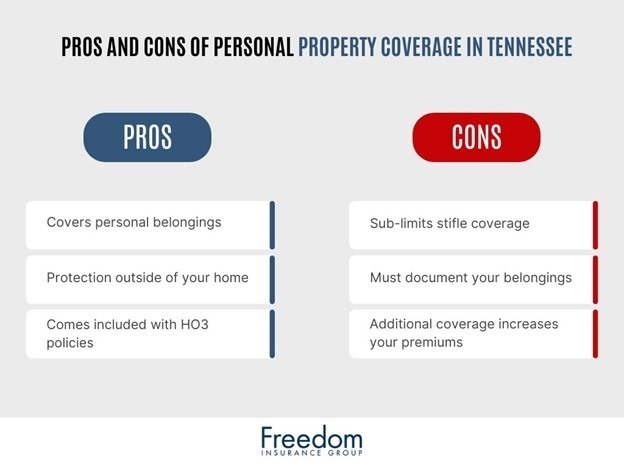
Having personal property coverage is important for all homeowners and it’s made easy because it comes with standard home insurance policies. However, there are still pros and cons when enrolling. Here’s what you need to remember about Coverage C:
|
Pros: |
Cons: |
|
Reimburses you for personal items lost |
Doesn’t cover everything due to sub-limits |
|
Covers a wide range of perils even outside of your home |
To receive reimbursement, you’re going to need to have documentation of your items |
|
An affordable option already within standard home insurance policies |
Additional coverage and riders mean higher premiums |
Get a Quote for Personal Property Coverage in Texas
Protecting your belongings doesn’t have to be a hassle. At Freedom Insurance Group, we work with 25+ top-rated home insurance companies to help you find the right coverage at the lowest price. Get a home insurance quote or ask an agent today for personal property coverage Texans can trust.
Sources:
Personal Property Coverage in Missouri
Summary: Personal property coverage (Coverage C), or contents coverage, helps Missouri residents protect their belongings. Available for homeowners and renters alike, you’re covered for personal property both inside and outside of your home. You’ll need to consider policy limits, however, there are options available to increase coverage limits or supplement protection. Estimated Read Time: 3 mins
Personal property coverage is part of home and renters insurance, protecting personal belongings like furniture, electronics, clothing, etc.
Contents coverage can extend to items outside your home, protecting against perils like theft and fire, however, there are limits on what it covers.
Missouri residents can safeguard their belongings from losses through affordable coverage options and should personalize their protection at an adequate level that helps avoid major financial losses.
Missouri Personal Property Coverage Isn’t Blanket Coverage
If you want to protect your personal property, standard home insurance in Missouri has your back.
However, just because personal property coverage is there to protect you, you’re not going to have everything covered.
Furthermore, things like jewelry or collectibles may require additional coverage as higher-end items may exceed your policy limits.
On many policies, some items aren’t included in protection unless they are specifically listed. This includes the following:
- Livestock
- Personal belongings that are lost
- Pets
- Plants
- Property used for your business
- Vehicles, ATVs, etc.
- Watercraft
Finding the Right Amount of Personal Property Coverage in Missouri
Having the right level of personal property coverage is crucial but it will look different for everyone.
You need enough personal property insurance to cover major losses, such as a fire to restore property damaged by perils covered by your home or renters coverage.
High-value items like art, high-end, designer clothing, or jewelry may not be accounted for and because these limits apply, you may need additional coverage to avoid costly losses.
Furthermore, high-value items may require appraisals and scheduling or a personal articles floater for proper coverage, depending on your policy and carrier.
Agents can help select endorsements with "stated value" coverage and lower deductibles to find the right level of protection while saving on premiums.
Replacement Value Vs. Actual Cash Value
When choosing the type of personal property coverage you need, you have options that will affect how much you pay but also the amount of compensation you receive when filing a claim:
- Replacement cost value (RCV) coverage, which allows you to replace items with new ones on a "new-for-old" basis after a loss. You receive a new, modern version of the lost item equivalent to what was lost.
- Actual cash value (ACV) coverage, which pays out compensation but only the depreciated value of your items. This reduces your insurance premium but you’ll receive a lower reimbursement.
You’ll need to decide which option works for you when enrolling. Be sure to assess the value of your items, your risk tolerance, and your budget when choosing.
Types of Coverage
Personal property coverage can be insured under named perils or all perils, depending on your policy type.
In Missouri, an HO-3 homeowners policy covers 16 named perils for contents insurance.
There is also an HO-8 form providing all-risk coverage, however, this is typically for newer homes in gated communities with alarms, as they come with fewer risks.
All-risk policies cover everything except excluded perils, often covered by separate policies like earthquake or flood insurance.
Missouri Scheduled Personal Property Coverage Explained
A scheduled property floater provides coverage for specific items, with limits agreed upon based on appraisals.
Unlike an unscheduled floater, it protects each item individually rather than by category.
Though it comes with higher premiums, the floater pays out per item, ensuring higher protection for valuables.
Items like jewelry, art, or collectibles are often listed under this type of floater, for example:
- A wedding ring with a 2 ct diamond in an 18 ct gold band appraised at $20,000.
- A Rolex GMT-Master II with an appraised value of $16,700.
- One antique Smith & Wesson Model 320 appraised at $14,000.
Unscheduled Property Floaters
An unscheduled property floater offers broad coverage for categories of personal items, like firearms, without needing to list each item individually. It assigns a coverage limit for the entire category.
This type of floater usually comes with a lower premium compared to a scheduled property floater and may be appropriate for specific belongings that may otherwise not have a proper way to be protected.
Get a Quote on Personal Property Coverage in Missouri
Keeping your personal belongings covered for less is as simple as comparing home insurance carriers in just a few clicks. Find affordable home insurance in Missouri using the tool below or ask an agent today to save on premiums.
Sources:
Personal Property Coverage in Tennessee
Summary: Personal property coverage, or Coverage C, safeguards Tennessee homeowners and renters by covering belongings both inside and outside the home. While standard policies have limits, you can easily boost your coverage to fully protect valuable items. By exploring different coverage options, you can find the right balance of protection and affordability. Comparing carriers and getting quotes helps you save while securing personalized coverage. Estimated Read Time: 3 mins
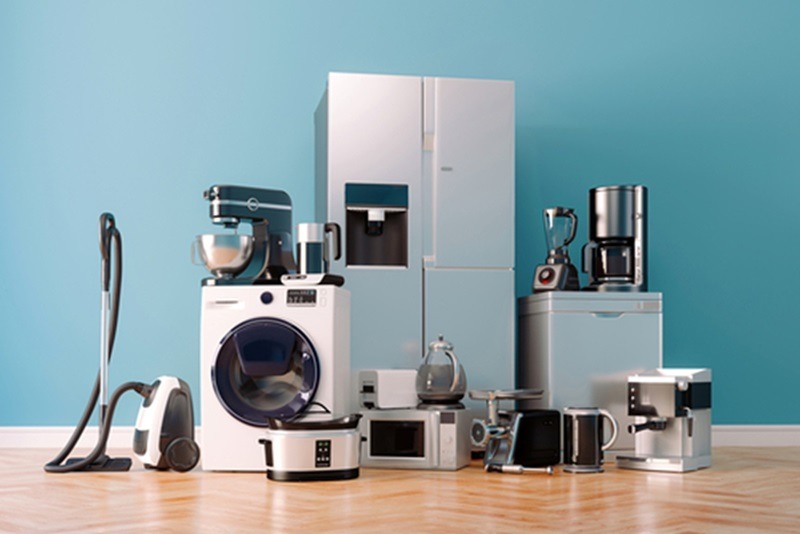
Just like your home may suffer a loss due to a fire or theft, your personal property needs protection too.
This includes things like costly electronics, pieces of furniture, clothing, and more.
Contents coverage protects items in your home and outside of it, but limits still apply.
Personal Property Isn’t Blanket Coverage in Tennessee
Standard home insurance in Tennessee offers protection for your personal property, but not everything will be covered.
You can customize your protection but personal property coverage is not blanket protection for everything you own.
For example, high-value items like jewelry or collectibles may exceed personal property coverage limits and require extra coverage.
Furthermore, many policies require specific listing for certain items to be included in the protection, such as:
- Commercial property
- Livestock
- Lost possessions
- Pets
- Plants
- Vehicles, ATVs, etc.
- Watercraft
How Much Personal Property Coverage You Need in Tennessee
The right level of personal property coverage varies for everyone, but you need to have enough insurance to cover major losses, like fire damage, based on what's covered by your home or renters policy.
High-value items like art, designer clothing, or jewelry may require extra coverage, as standard limits might not fully protect them.
Appraisals and scheduling or a personal property coverage floater may be necessary for proper protection.
Agents can help choose endorsements with "stated value" coverage and lower deductibles to provide the right protection while managing premiums.
Overall, the right amount of insurance is going to provide you with an affordable premium while protecting against large financial losses you may otherwise not be able to recover from.
RCV Vs. ACV
When selecting personal property coverage, your choice will affect both your premium and the compensation you receive after a claim.
With replacement cost value (RCV) coverage, you can replace lost items with new ones. This "new-for-old" option ensures you get a modern equivalent of the lost item, providing full compensation.
On the other hand, actual cash value (ACV) coverage offers a lower payout by covering only the depreciated value of your items. While it reduces your reimbursement, your insurance premium will also cost less.
When enrolling, consider the value of your belongings, your risk tolerance, and your budget to decide which option is best for you.
Coverage Types
Depending on the policy, personal property coverage can be insured under named perils or all perils.
In Tennessee, an HO-3 homeowners policy provides contents coverage for 16 named perils.
For newer homes in gated communities, an HO-8 form may be available, offering all-risk coverage, as these properties generally carry fewer risks.
All-risk policies cover everything except excluded perils, which are often addressed through separate, additional policies, such as earthquake or flood insurance.
Tennessee Scheduled Personal Property Coverage Explained
A scheduled property floater covers specific items with limits based on appraisals.
Unlike an unscheduled floater, it protects each item individually, offering higher payouts for valuables like jewelry, art, or collectibles.
While this is advantageous for some items, note that you'll have to pay higher premiums for this protection. Here are some examples of when it can come in handy:
- A wedding ring with a 2 ct diamond in a 14 K white gold band appraised at $13,000.
- A Santos de Cartier watch with an appraised value of $7,050.
Unscheduled Property Floater
You can add an unscheduled property floater to cover specific items, such as a firearm, by listing them individually and then having a coverage limit apply to the category as a whole.
These floaters are typically cheaper than scheduled property floaters and can help you protect certain personal items that may otherwise be difficult to find coverage for.
Save on Personal Property Coverage in Tennessee
If you’re looking to increase your personal property coverage, save on home insurance premiums, or find protection for a specific item, be sure to compare carriers.
Get a quote by using the tool below or ask an agent to compare companies near you for personalized coverage from top-rated carriers:


